Wednesday, January 30, 2013

Mitosis Activity

Wednesday January 30th
During Mitosis what do you think would be the result if Metaphase was skipped and the cell went straight into Anaphase? (Draw a Picture of what this would look like)
  The chromosomes would not separate equally and each of the resulting Nuclei would have different DNA. - Or as Mia so PERFECTLY put it during 3rd period "It would be like telling a bunch of 1st graders the ice cream man is here and giving away free ice cream but now making them line up in a single file"
 
 
I look under a microscope and notice a group of cells. Some cells have a nucleus that looks very “messy” with no defined structures.  There is one cell though that has very distinct structures forming within the nucleus.  What are these structures, what is so important about them being visible now, what stage of mitosis could we infer it is in?

 The Structures are Chromosomes, what is important about them being visible now is that they have condensed (this marks the beginning of mitosis) therefore this would be a cell in prophase
What about the “messy” cells – what stage of the cell cycle are they in? The other cells around would be in interphase.  At this time the DNA is uncoiled and looks just like a "blob".
 
THEN we turned the classroom into a nucleus.  With all 46 chromosomes that would be present in of our cells.  Check the pics below and their descriptions for more details on that.
 
Mitosis Activity
FIRST, i placed a couple chromosomes on each of your desks.  Once there were 46 chromosomes "visible" in the room our nucleus would be in prophase. (The chromosomes have become visible because they have condensed) Then we moved into metaphase
You lined up the sister chromatids at the center of our nucleus

Making sure to line them end to end and NOT next to each other

Next step was Anaphase!
You started to pull the sister chromatids away from
each other.  (you were acting like the spindle fibers
at this point.)


Mitosis Notes


Tuesday January 29th
The two most important stages of mitosis to understand are metaphase and anaphase.  These two phases make sure that DNA is divided equally between the two “daughter cells” What is happening during these two phases? 
During Metaphase sister chromatids are lining up in the middle of the nucleus and the splitting apart during anaphase.

We then went through the following notes and did worked through mitosis with our chromosome models.


These would be chromosomes that have condensed
and became visible but have not "arranged" themselves
yet.
the chromosomes have lined up at the center of your
nucleus so that sister chromatids will be separated.


Intro to Mitosis

Monday January 28th
During the S phase of interphase DNA is replicated.  At his point we have made duplicated chromosomes.  These will then be split apart in a process known as mitosis.  Mitosis ONLY occurs in Eukaryotic Cells.  With this information we can infer that mitosis is the division of the Nucleus which stores genetic information in Eukaryotic cells.

There is actually a LOT we can learn/recall from this question.  Today I encouraged more of the THINKING behind the question than the answer itself.  The FIRST place your mind should have gone is determining what OTHER type of cell there is (since I told you that this occurs in Eukaryotic cells).  The other type of cell is prokaryotic.  The next place to go then is recalling the difference between eukaryotic and prokaryotic cells.  There are a couple differences between the two, but since I am asking about a part of the cell that "Stores genetic information" this should have jogged your memory that only Eukaryotic cells have a nucleus.  Therefore the answer was nucleus.
After that I had you at least write the stages of mitosis.  Tomorrow and the next day we will actually discuss these notes and work through a couple demonstrations to help you learn it.

Monday, January 28, 2013

DNA, Chromosomes, Cell Cycle wrap up

We started Friday with the following daily question and discussion.  After that we took our first daily question quiz of this nine weeks!
Friday January 25th
DNA replication is said to be semi-conservative.  How are the two DNA molecules related to each other?  They are IDENTICAL sequences but each has one Old strand (or template strand) and one NEW strand.  Recall how we saw this with our Kinex models below.
The enzyme DNA polymerase has two very important functions.  First is they are responsible for adding new Nucleotide bases (accoridng to the base pairing rules) to each side.

The second is that it acts like a “ Proof reader"

What do you think would happen if DNA polymerase didn’t do it’s “Job”  The DNA may have a mistake in it.  ANY mistake in DNA (whether is changes the function of the cell or not) is known as a mutation.

Thursday, January 24, 2013

DNA Replication Activity

Today we started with the following Daily Questions.  To help you answer them I played the two videos below.

Thursday January 24th
What does DNA “make” (Provide the instructions for) Proteins
What is DNA COMPOSED of? (Made up of) Nucleotides
Each strand is said to be Complementary to the other.
During DNA Replication, what molecules in the cell do the “work” involved? Enzymes

Then we went through the three steps of DNA replication as we worked through the notes.  Here are the notes and some pictures of the activity.


Wednesday, January 23, 2013

More DNA Daily Questions

Wednesday January 23rd
Which statement best describes the relationship between cells, DNA, and proteins?
(1) Cells contain DNA that controls the production of proteins.
(2) DNA is composed of proteins that carry coded information for how cells function.
This would be correct IF it said that DNA is composed of NUCLEIC ACIDS instead of protiens.  DNA is not COMPOSED of Proteins - DNA CODES for proteins.
(3) Proteins are used to produce cells that link amino acids together into DNA.
(4) Cells are linked together by proteins to make different kinds of DNA molecules.
(#3 and #4 are just INCORRECT)
What are genes composed of?
(1) offspring   (2) DNA   (3) cells  (4) traits (this would be correct if the question was what do genes CODE for)
 

Tuesday, January 15, 2013

DNA structure daily questions


Tuesday January 15th
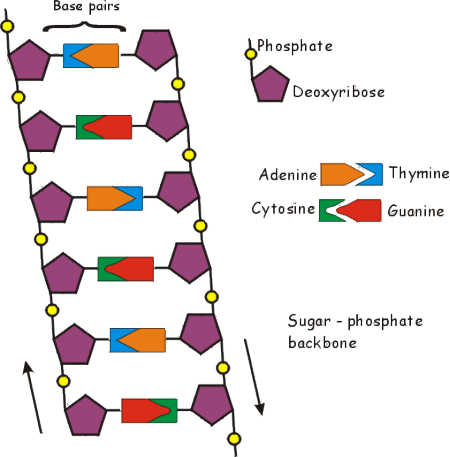
DNA is made up of nucleotides.  What are the three parts that make up a nucleotide?
A sugar (deoxyribose) a phosphate group and one of four nitrogen bases.

Of these, which two make up the backbone? The sugar and the phosphate groups

Which make up the “code” that writes our instructions? The nitrogen bases

There are 4 different “codes” in DNA, what are they and how do they pair up? Adenine, Guanine, Thymine and Cytosine
Adenine and Tymine (A and T) pair up
Guanine and Cytosine (G and C) pair up

When during the cell cycle does DNA replicate?
During the S-Phase (Synthesis phase)

After this we watched the first part of the following crash course (up until he starts talking about RNA) followed by a a worksheet that summarizes what we have learned so far about chromosomes, genes, DNA and the cell cycle.  This is due tomorrow!!

DNA Structure Notes


Monday, January 14, 2013

Eukaryotic Cell Cycle

Today we finished up the first section on how a cell prepares to divide and moved into the Eukaryotic cell cycle.  We started with the following daily questions.  After that, these are some of the slides that we used to answer the cell reproduction and Eukaryotic cell cycle notes.
Monday January 14th
Which Cell provides the most efficient surface-area to volume ratio and WHY?

the FIRST cell (the smallest) because it would have the largest surface area to volume ratio.  This is important because molecules are moving into and out of the cell all the time, and the more surface area there is for substances to travel the more efficient the cell would be.   
 Before a cell can divide what must the cell make a copy of?
ALL of the DNA found in the cell must be copied so that each new cell has a full copy (not just half)
Draw out what a duplicated chromosome would look like labeling the different parts.  Then describe how the two sides are related.


Friday, January 11, 2013

Midterm Corrections and Extra Credit for End of Nine Weeks

There IS hope even if you didn't do to great on your midterm. 

I gave you all the following announcement - But..........For BlOG READER ONLY (and any body who has me from 5th period on) I changed the date to TUESDAY instead of Monday!!!

Midterm Exam Corrections

The DEAL of a lifetime – RIGHT here – RIGHT now!!!!!!!!
You have the opportunity to gain half of the points back that you missed on the midterm by doing the following.
You will WRITE OUT the question (you don’t have to draw diagrams or charts) and WRITE OUT the answer (don’t just tell me the letter)
Bring this back by Tuesday – With your original answer key and you will receive a half point for each corrected answer.
Remember – these questions do NOT require you to just “look up” something in your notes or the book.  FIRST you need to tear the question apart and determine what I am asking.  THEN take the information I have given you and APPLY it to the situation I am giving you!  Very few of these would be found directly in your notes or the book, it requires more thinking than that. 
If you decided to do this hopefully you picked up a copy of the exam.  If not - Check Edline, I put an electronic copy on there as well.
In addition, there was an end of the nine weeks extra credit option.  This was answering writing prompts from a National Institute of Healh publication called "The New Genetics"  For each full page you complete it was worth 5 bonus points. (So you could recieve up to 25 bonus points on this alone!!!)

Chromosomes, DNA, Genes and how they all interact!

Today we were back to keystone exam questions and I grouped you up to go through these daily questions and not only tell me the correct answer but HOW you got to the answer (this required much more thinking!!!)
Which sequence of terms represents a decrease from the greatest number of structures to the least number of structures present in a cell?
(1) nucleus → gene → chromosome
(2) gene → nucleus → chromosome
(3) gene → chromosome → nucleus***** Correct answer - How did you get their? FIRST you had to do decide which term represented the LEAST number of structures in a cell. A cell only contains ONE nucleus. Within that nucleus are MANY chromosomes (humans have 46) and those chromosomes contain THOUSANDS of genes.
(4) chromosome → gene → nucleus
Chromosome is to nucleus as DNA is to (1) cytoplasm
(2) gene** Correct answer - Look at the relationship between Chromosomes and the Nucleus. Chromosomes are structures found inside the nucles (they are a smaller part of the nucleus.) All of our DNA is made up of smaller sections known as genes.
(3) cell membrane
(4) chloroplast

Many cells have a nucleus that contains chromosomes. These chromosomes carry genes that are composed of (1) hormones
(2) DNA molecules** Correct: Why??? Because it was a Vomit question - Chromosomes are made up of DNA - its right from our notes!
(3) minerals and water
(4) undigested food molecules

After that we continued through our discussion of the reading you did as we move through the basics of the DNA replication and how a cell prepared for cell division.
 

Thursday, January 10, 2013

Back in the swing of things.... With Cell Reproduction

With the exception of a few students, you have all taken the midterm exam.  As of now there will be a 2% curve on all tests because the highest score was a 98%  Everyone will receive these two % points.  You will ALSO have the opportunity to correct your answers to receive half of your points back.  Stay tuned for that tomorrow along with an extra credit option.

When you weren't taking your exam, you were reading through the next couple sections in the book and filling out a reading guide on these.  Today we started with the following daily questions.

Thursday January 10th
About how many cells does your body make EVERY day?????? 2 Trillion
Where do these cells come from? Pre-existing Cells
What limits the size in which cells can get? The Surface Area to Volume Ratio and the DNA 
BEFORE a cell divides, what MUST happen first?? All the "equipment" a cell needs to function needs to copy (including the DNA)
After this, using the online book we went through the first couple pages of our first guided reading.  Remember, you ALL have access to this book by going to edline, clicking on the Online Book link and using one of the usernames to log on.  (here is the list of them, it doesn't matter which you use, they were automatically generated).  
Use any of the following user names To access the online book go to http://my.hrw.com
ALL passwords arebiology
Usernames:
bbiology20
cbiology19
dbiology1
ebiology8
fbiology7
gbiology9
hbiology28
ibiology3
jbiology7
kbiology3
lbiology6
mbiology16
nbiology3
obiology5
pbiology5
rbiology5
sbiology79
tbiology7
vbiology2
wbiology2
ybiology1
zbiology1