Tuesday, January 26, 2016

Monday and Tuesday January 25th and 26th - DNA Replication in Detail

The past few days have been full of coloring and crash coursing it and K'nex modeling it.....   It's been pretty active in class these past two days learning about DNA replication.  The reminders and goals for both Monday and Tuesday were the same:

Yesterday was Day one of DNA replication in detail.  We started the class off with the following daily questions.   We spent a LOT of time on these and were very careful to draw out DNA replication.
I added one more drawing of this.  The thing to keep in mind here are the COLORS of the different DNA strands.  You will notice that at the END (the bottom two DNA molecules) - Each one is composed of one ORIGINAL DNA strand (The blue strand) and one NEW DNA strand (the green strand)

 That second question was really still referring to the the first question.  It is KEY to understand this concept of DNA replication being "semi conservative"!

We then got down a couple notes to prep us for another activity that we did today:

Today's Daily Questions went RIGHT along with these two slides and led us into an activity using the K'nex models.

First we acted like DNA HELICASE and "Unzipped the genes."  What does THAT mean????  Well FIRST we need to know what the "zipper" is made up of to begin with - The nucleotide strands are held together by HYDROGEN BONDS.  So the role of these Helicases are to break hydrogen bonds

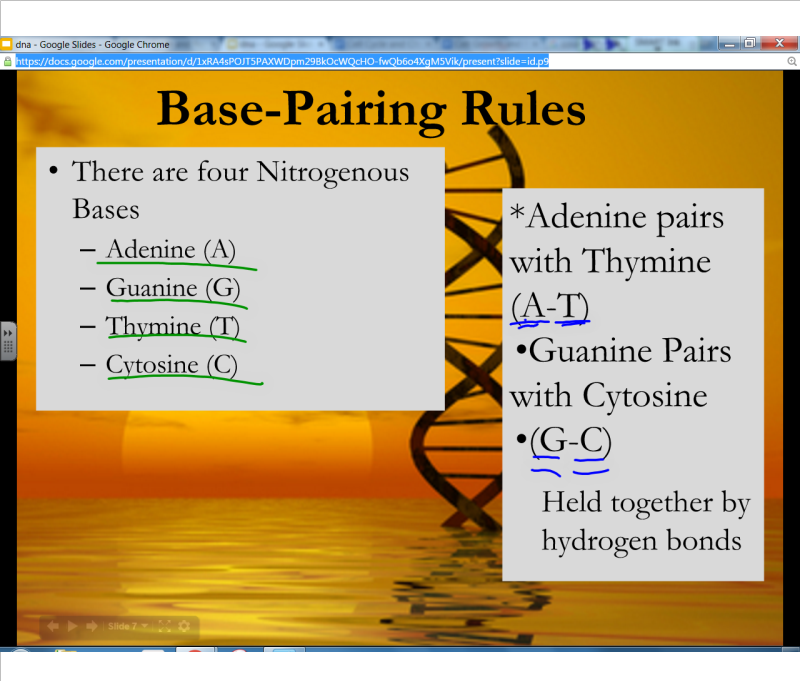
Next up - We acted Like DNA POLYMERASE and started adding new nucleotides to either side at the "replication fork."  How did we KNOW what to add????  We used the base pairing rules A-T and C-G


and FINALLY..... We ended up with TWO IDENTICAL DNA Molecules - each consisting of one "Old" Strand (the gray backbone) and one "New" Strand (the yellow backbone)


Then you started on a worksheet to see how much of this you retained (and showed me that hopefully this time working with the K'nex models helped your comprehension of the subject more rather than take you back to your younger days of just building roller coasters with K'nex models....?!?!)

Here was the general concept of the worksheet

Friday, January 22, 2016

Cell Cycle and DNA Structure Daily Question Quiz - DNA Replication Interactive Assignment

Click on the link or the picture to start the daily question quiz
*


THEN......  Watch the following Crash Course Video and on a Note card - Tell me Four things about the STRUCTURE of DNA and Four things about DNA REPLICATION.  These can be quick bulleted points.  ou do NOT need to write complete sentences. 

Thursday, January 21, 2016

Thursday January 21st DNA structure and Function Day 2

We had the same goals as yesterday and similar reminders..... 
(Except the give someone a hug thing.... It was "National Hug Day" today)

Daily Questions:
Then we continued with our Notes and Activities on the Structure and Function of DNA


AAAAAAAAAAAAAAND - I let you watch this hilariously terrible DNA video ;)
Finally - I gave you an introduction to what we will start into Tomorrow / Monday


Wednesday, January 20, 2016

Wednesday January 20th - DNA structure and Function Day 1

Goals and Reminders for Today:


We only had ONE daily Question Today because of a graded assessment that came AFTER.
The next 10 minutes you worked through the following assignment and we graded it right here in class.


THEN - into a couple notes about the nucleotide structure and we started to build a strand of nucleotides.


Missed out Discussion on DNA structure?????  Check out the following YouTube clip:
p.s.  Don't worry about 3 prime / 5 prime information - you will not need to know THAT much detail!!

Tuesday, January 19, 2016

Tuesday January 19th - DNA introduction

Tuesday January 19th - 
Goals and reminders for Today:


We started off with daily questions as usual:

Then started into a little bit of notes. These were to give you a little bit deeper look at the terms Genome, DNA, Genes, Chromosomes, etc.


More about the structure of DNA tomorrow!!

Thursday, January 14, 2016

Thursday January 14th Cell Growth and Reproduction Introduction

We have our 2nd round of CDTs under our belts and have started into second semester content.  

Before we get into the new stuff... let me remind you that TOMORROW IS A MAKE UP DAY!!!  Retake things, turn in things you are missing, finish your extra credit.  WHATEVER it takes to succeed!!

I also have created a google form for you to fill out if you would like to be exempt from a daily question quiz or assignment.  KEEP IN MIND - IF YOU ARE MISSING ONE OF THESE YOU CAN NOT BE EXEMPT FROM ONE!!  You CAN choose to be exempt from THAT if you are missing it though!!!

Click the image below to be forwarded to the exemption form.
NOW to 2nd semester content:

To start us off we will be learning about cell growth and reproduction.  Some of the big topics in this chapter will be
*  Cell Cycle
*  Mitosis vs Meiosis
*  Cell Cycle Control

We got right back into daily questions.  Here were the DQs from yesterday and Today


AND... We started into our first set of notes for the semester:


Thursday, January 7, 2016

WOW it's been a while!!!! Midterm Info

Alright guys..... So we made it back after Christmas Break and started prepping for our midterm.  All this week I guided your studying by having you create Study Guides.  Remember I have told you that I structure the class so that even if you NEVER looked at things outside of class, you should at least be able to say you succeeded.  You may not be able to ace it, but you will be prepared!!

I encouraged you to login to study island and take the practice midterms so that you can learn from your mistakes!!!

There were three study guides I had you build based on the Keystone Exam big ideas

If you click on the links for each topic it will take you to that sections book pages. In the meantime I have made SUPER SIMPLE outlines of each topic.
  • 1st:  Basic Biological Principles
    • Characteristics of all living organisms
      • Obtaining and using energy
      • Homeostasis
      • Growth
      • Reproduction
      • Respond to stimuli
    • Prokaryotic and Eukaryotic Cell Structure and Function
      • Characteristics of ALL cells:
        • Surrounded by a cell Membrane
        • Filled with cytoplasm
        • Contain DNA
        • Have ribosomes where proteins are assembled
      • Prokaryotic Cells
        • SUPER small and simple (are always unicellular)
        • DNA located in the cytoplasm (they do not have a nucleus)
        • Bacteria and Archaebacteria are ONLY organisms that are prokaryotic
      • Eukaryotic Cells
        • MUCH more Complex
        • DNA is found in the NUCLEUS
        • Contain many Membrane Bound organelles
        • Can be unicellular or multicellular
    • Organelle Structure and Function
      • Nucleus - stores genetic information
      • Mitochondria - the "power house" of the cell - This is where ATP is produced
      • Endoplasmic reticulum - Contains ribosomes that assemble proteins that will be shipped out of the cell.  The ER helps package them up into vesicles
      • Golgi Apparatus - Continues preparing the vesicles to be transported out of the cell
    • Multicellular Organization
      • Smallest unit of Organization is a CELL
      • Cells are SPECIALIZED in multicellular organisms
        • ****STRUCTURE DETERMINE FUNCTION!!!!
      • A group of specialized cells make up tissue
      • A group of tissues make up an organ
      • Different organs together make up organ systems
      • All organ systems working together make up an organism
  • 2nd  Chemical Basis for Life
    • Properties of water that help support life
      • Water is a POLAR molecule which allows it dissolve many substance
      • Water molecules bond with each other by HYDROGEN BONDS
      • This hydrogen bonding is reason water has properties that help it support life on earth
        • Cohesion - Waters attraction to other water molecules
          • Causes Surface tension
        • Adhesion - Waters attraction to other polar molecules
          • along with cohesion causes capillary action
        • High Specific Heat - water is able to absorb and retain a large of amount of heat without changing temperature
          • important for maintaining mile environment for aquatic organisms
          • Important for maintaining a constant body temperature in humans
        • High Heat of Vaporization:  When water goes from a liquid to a gas a TONE of heat is released which helps animals that sweat to cool down
        • Density - Water is LESS dense as a solid which allows ice to float.
    • Atomic properties of Carbon that allow it to form macromolecules
      • Is able to bond with up to 4 other atoms (has 4 valence electrons and WANTS to have 8 electrons in its valence shell.
    • How Macromolecules are Formed from monomers
      • Carbohydrates - Made up of Saccharide monomers
      • Lipids - Make up of fatty acids and glycerol
      • Proteins - Made up of amino acid monomers
      • Nucleic Acids - Made up of nucleotide monomers
    • Functions of Macromolecules
      • Carbohydrates - Energy supply, Cell recognition, structural components (i.e. cellulose and chitin.)
      • Lipids - MAJOR energy storage, water barriers (waxes), some types of hormones, insulation.
      • Proteins - a WIDE variety of functions based on how the amino acid chain is folded (STRUCTURE DETERMINES FUNCTION!!!) - some examples:  antibodies, enzymes, structure (such as keratin)
      • Nucleic Acids - Store GENETIC INFORMATION (DNA and RNA)
    • Enzymes
      • Act as catalysts in biochemical reactions 
        • SPEED up chemical reactions by  lowering the amount of energy needed to start a reaction. (lowers the activation energy)
      • Are SPECIFIC to different reactions
      • Are NOT USED UP in chemical reactions
      • Can be denatured by changes in pH and Temperature. 
        • This can change the shape of the enzyme and if the active site is changed it can no longer bind the specific substrate and therefore cannot help that reaction.
  • 3rd - Homeostasis and Transport
    • Structure and Function of the cell membrane
      • Composed of a phospholipid bilayer with proteins embedded within it.
        • Is SEMI permeable (allows small nonpolar molecules to move easily through but not ions, polar molecules or other large macromolecules)
        • Phospholipids have two regions
          • Polar (hydrophilic) phosphate heads that face the surfaces
          • Nonpolar (hydrophobic) Fatty Acid Tails that make up the middle of the membrane
      • Membrane proteins
        • Transport proteins (Carrier and Channel proteins) aid in the movement of polar molecules, ions or larger molecules across the membrane
        • Glycoproteins - Located on the outside surface of the cell and act as a "name tag"
        • Receptor Proteins - Receive signals (such as hormones) that are transmitted inside the cell to initiate a chemical reaction
        • Enzymes - Located on the inside surface of the cell to aid in biochemical reactions
    • Passive Transport
      • Does NOT require the input of energy
      • Movement of molecules DOWN the concentration gradient (from an area of high to low concentration)
      • Examples:
        • Simple diffusion - small nonpolar molecules such as carbon dioxide and oxygen move directly through the phospholipids
        • Facilitated diffusion - movement of polar molecules or ions through transport proteins
        • Osmosis - specifically the movement of water across the cell membrane (through aquaporins)
    • Active transport
      • REQUIRES the input of energy - usually in the form of ATP
      • Creates a concentration gradient (by moving molecules from LOW to HIGH concentration.
      • Examples
        • Molecular and ion PUMPS
          • Pump molecules / ions AGAINST their concentration gradient
            • BIG example = SODIUM POTASSIUM PUMP
        • Movement through vesicles 
          • Endocytosis - Moving large molecules INTO the cell
          • Exocytosis - moving large molecules OUT OF the cell
  • Bioenergetics (You did not do a study guide on this since we just finished this unit and you should have a study guide from the test)
      • Basic Energy Transformations that occur during photosynthesis and cellular respiration
        • Photosynthesis - Solar to chemical conversion (Chemical energy is store in the bonds of organic molecules like glucose)
        • Cellular Respiration - Chemical to Chemical conversion (Stored first in the bonds of glucose and at the end it is stored in the bonds of ATP)
      • Relationship between Photosynthesis and Cellular respiration
        • The products of photosynthesis and cellular respiration are in essence reversed.  The only difference is that end the end of cellular respiration light energy is not created but instead chemical energy found in the bonds of ATP that is stored by the cell for usable energy to power chemical reaction
      • Role of chloroplasts and Mitochondria
        • Chloroplasts - Organelle in which photosynthesis occurs 
        • Mitochondria - Organelle in which aerobic cellular respiration occurs

YOU GUYS ARE CAPABLE OF DOING GREAT ON THIS!!!

BUT..... at the same time - don't forget this is just the first run at the midterm.  LEARN FROM YOUR MISTAKES!!  You will have the opportunity next week to retake it.