 |
| Hopefully this is NOT the math you have done in determining if you are going to study or not for this exam :) |

Monday, May 21, 2012
So here we are!!!!

Tuesday, May 15, 2012
Natural Selection Wrap Up
Most of you finished the notes on this section yesterday. Today we went back through and I highlighted a few key areas. Most specifically we talked about how there is a delicate balance between the ability to not only survive but also reproduce. Embedded in the notes was the following video clip that summarizes this balance.
You then received questions on this chapter that will act as your test. I mentioned before that there would not be a stand alone test for this chapter but it WILL be a part of your final. Tomorrow we will have an open notes quiz, Friday we will have a daily question quiz and what i handed out today will be due on Monday.
Here were today's daily questions.
Here were today's daily questions.
Tuesday May 15th
*What did Darwin believe fueled evolution (1st step of
evolution by natural selection) Overproduction (The fact that organisms have the capability of producing more offspring than the environment they live in can hold)
*This was based off of Malthus’ findings that human population grows
Exponentially while the food supply grows Linearly.
*The second step in Darwin’s theory is that individuals in a population
exhibit variation. This
“variation” is due to different Alleles.
*Which statement best describes a current understanding of natural
selection?
A.
Natural selection influences the frequency of an adaptation in a
population
B.
Natural selection has been discarded as an important concept in
evolution
C. Changes in gene
frequencies due to natural selection have little effect on the evolution of species.
D.
New mutations of genetic material are due to natural selection.
Monday, May 14, 2012
Natural Selection Details


Darwin applied his findings to how humans breed
animals for certain traits. This
is known as……..
Artificial Selection
One of Darwin’s Influencers, Lamark believed that
what was passed on to future generation was dependent on what? - The Use or disuse of a trait
Friday, May 11, 2012
More About Darwin
We continued today with looking at not only Darwin, but those who influenced Darwin's ideas.
I want to stress again that we will be applying our understanding of genetics and heredity to what Darwin was seeing. I mentioned before that during the time Darwin was coming up with his ideas there was no scientific knowledge about heredity or DNA so he referred to all of this as "variations" and "Copying mechanisms" Please continue to check edline for the notes. Today's Daily questions were as follow
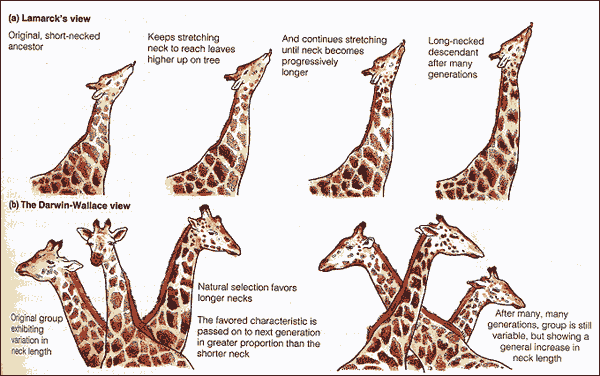 |
| Lamark felt that traits that are USED are passed on. So he thought that giraffe necks had grown longer from stretching them so much. |
 |
| If Lamarks idea held true that would mean the the son of this baseball pitcher would automatically have a strong arm. |
I want to stress again that we will be applying our understanding of genetics and heredity to what Darwin was seeing. I mentioned before that during the time Darwin was coming up with his ideas there was no scientific knowledge about heredity or DNA so he referred to all of this as "variations" and "Copying mechanisms" Please continue to check edline for the notes. Today's Daily questions were as follow
*What did Darwin notice about the finches and what did that lead him to believe about the “evolution” of them? He noticed that their beak shapes directly corresponded to the type of food they ate. What he theorized was that the finches has migrated from the main land of South America and overtime adapted to different food sources. He called this "Descent with modification"
*With our understanding of genetics, these different “variations” are known as what? Alleles
*What do you think caused these different variations? Mutations
*What two types of variations do you believe would provide an “advantage” to a species? Any allele that would allow them to survive (eat and not be eaten) and reproduce.
Thursday, May 10, 2012
Introduction to Evolution
After the test on Tuesday I let Wednesday be a make up day. Today though we started in to our LAST chapter of the year!!!! Evolution and natural selection. You did learn a little about this in 8th grade environmental science but we are going to move a step farther and look at the GENETICS behind it. You saw today that this chapter is going to be a good way to put together ALL we have learned this semester. The daily questions today acted as a "pre-test." These were sample keystone exam questions. After the daily questions we started into the beginning of the notes giving a background on who Charles Darwin was and what his discoveries were. There was a little clip that i had you watch below
When the crazy bird was talking - THAT was when it started to bring the last chapter into play. He mentioned that there must be some "copying" mechanism that can have "errors" in it for new traits to arise. We discussed that the "copying' mechanisms would be mitosis and meiosis followed by fertilization and the "errors"would be mutations then.

So.........how are we going to put this into action?!?!? We will be looking at why using SOOOOOO much hand sanitizer and the over use of antibiotics are creating "super bugs" that are resistant to EVERYthing!!!! So lay off the hand sanitizer guys :)
Here were your daily questions - please check Edline for the notes!!
1. Which population of organisms would be in greatest danger of becoming extinct?
***A population of organisms having few variations living in an unstable environment.
*Having little variation is not a good thing when a major environmental change occurs.
2. In order for a new species to develop, there must be a change in the
**Genetic makeup of a population. (This can be DUE to a change in the temperature or migration patterns, but ultimately it comes down to a change in the allele frequencies of a population)
3. Which statement is NOT part of the concept of natural selection?
A. Individuals that possess the most favorable variations will have the best chance of reproducing.
B. Variation occurs among individuals in a population
C. More individuals are produced than will survive
D. Genes of an individual adapt to a changing environment***GENES do not adapt - individuals adapt and populations adapt - but genes do not. They may "change" due to random mutations though.
 ** 2 - a decrease in the advantage of having white fur. Since over a 10 year period the presence of ANY white rabbits was eliminated, that most likely means that having white fur was no longer a good thing.

So.........how are we going to put this into action?!?!? We will be looking at why using SOOOOOO much hand sanitizer and the over use of antibiotics are creating "super bugs" that are resistant to EVERYthing!!!! So lay off the hand sanitizer guys :)
Here were your daily questions - please check Edline for the notes!!
1. Which population of organisms would be in greatest danger of becoming extinct?
***A population of organisms having few variations living in an unstable environment.
*Having little variation is not a good thing when a major environmental change occurs.
2. In order for a new species to develop, there must be a change in the
**Genetic makeup of a population. (This can be DUE to a change in the temperature or migration patterns, but ultimately it comes down to a change in the allele frequencies of a population)
3. Which statement is NOT part of the concept of natural selection?
A. Individuals that possess the most favorable variations will have the best chance of reproducing.
B. Variation occurs among individuals in a population
C. More individuals are produced than will survive
D. Genes of an individual adapt to a changing environment***GENES do not adapt - individuals adapt and populations adapt - but genes do not. They may "change" due to random mutations though.

Monday, May 7, 2012
Preparation for DNA-RNA-Gene Expression Exam
Today was a day to prepare for the DNA-RNA-Gene Expression Exam. You will use Honors Bio link for the review game. PLEASE refer to this as well as the study guide in preparation for this exam. This is NOT the time to "check out" from school. We still have 3 weeks of content before we begin preparing for the final. Many of you cannot afford to let this 9 weeks go down the drain. As always.... talk to me / email me if you are confused on something or if you have realized the hole you have dug yourself is one that you wish to pull yourself out of!!!
Here is the review game link http://jeopardylabs.com/play/miss-evrards-honors-biology-review-games
Here is the review game link http://jeopardylabs.com/play/miss-evrards-honors-biology-review-games
Thursday, May 3, 2012
DNA RNA and Gene Expression Wrap up
We have slowly but surely been wrapping up this chapter. Today I gave you a study guide full of questions that sum up this chapter. Tomorrow we will have our usual Daily Question Quiz and then you will have time to continue with that. Monday I am planning for our formal review with the test being on Tuesday.I will have you turn in this packet on Tuesday so you have it to study for the test. We are almost there guys!!Hold strong and "Just keep swimming, just keep swimming, just keep swimming, swimming, swimming" - I know its hot in here - complaining about it doesn't make it any better!!

Wednesday, May 2, 2012
Mutations continued
Today we finished up the notes on mutations and watched a clip about a specific mutation that causes Polydactylism (having extra fingers/toes) we started the class off with the following daily questions
A. It is always known as a mutation
B. It is always advantageous to an individual
C. It is always passed on to offspring
**A mutation occurs in a cell. Which sequence best represents the correct order of events involved for this mutation to affect the traits expressed by this cell?
A. Change in DNA bases → Change in amino acid sequence → change in appearance of characteristic
B. Change in amino acids → change in DNA bases → Change in characteristic
C. Change in characteristic → change in amino acids → change in DNA bases
D. Change in DNA bases → change in characteristic → Change in amino acids
**True of False: DNA that is mutated in our lifetime in somatic cells will be passed on to our offspring. FALSE!!! Only DNA inn our germ line cells (those that will go through meiosis and become our gametes) will be passed on to our offspring. Mutations that occur in our somatic cells DURING our life will not be passed on.
**Which of the following types of mutations would have the greatest affect on the protein that the gene codes for? Missense, Silent or nonsense?
Nonsense: A nonsense mutation causes a premature stop codon - so the rest of the amino acid chain will not even be made. Missense can still have a large affect on the protein, but in general we would probably see the biggest affect with a nonsense mutation.
After the daily questions and finishing the notes on mutations I had you watch the following clip. We talked about the trait for 6 fingers when we learned about heredity. If you recall I mentioned that having 6 fingers was actually a dominant trait. What that means is in order to have a child with 6 fingers, one of the parents HAD to have had Six fingers. In this case the father did, but as with most people who are born with an extra didget - it was removed as a child. The odd thing about this case is that the baby has a fully functional 6th finger AND 6th toe. This now brings into our discussion on gene expression. Rememer, when and how genes are expressed is VERY complex. Obviously this little boy is fully expressing the gene in both his hands and feet. His father, on the other hand, may have only been expressing the gene "slightly" in his hands and not at all in his feet.
Wednesday May 2nd
**True or False: Mutations = ALWAYS BAD…… FALSE!!! A mutation does not ALWAYS mean something bad will occur. Mutations can be adventagous at times, they can be harmful or they may simple have no affect at all on a characteristic. The term mutation simple means there is a change in genetic material.... The end!!!!**Which statement is true regarding an alteration or change in DNA?A. It is always known as a mutation
B. It is always advantageous to an individual
C. It is always passed on to offspring
**A mutation occurs in a cell. Which sequence best represents the correct order of events involved for this mutation to affect the traits expressed by this cell?
A. Change in DNA bases → Change in amino acid sequence → change in appearance of characteristic
B. Change in amino acids → change in DNA bases → Change in characteristic
C. Change in characteristic → change in amino acids → change in DNA bases
D. Change in DNA bases → change in characteristic → Change in amino acids
**True of False: DNA that is mutated in our lifetime in somatic cells will be passed on to our offspring. FALSE!!! Only DNA inn our germ line cells (those that will go through meiosis and become our gametes) will be passed on to our offspring. Mutations that occur in our somatic cells DURING our life will not be passed on.
**Which of the following types of mutations would have the greatest affect on the protein that the gene codes for? Missense, Silent or nonsense?
Nonsense: A nonsense mutation causes a premature stop codon - so the rest of the amino acid chain will not even be made. Missense can still have a large affect on the protein, but in general we would probably see the biggest affect with a nonsense mutation.
After the daily questions and finishing the notes on mutations I had you watch the following clip. We talked about the trait for 6 fingers when we learned about heredity. If you recall I mentioned that having 6 fingers was actually a dominant trait. What that means is in order to have a child with 6 fingers, one of the parents HAD to have had Six fingers. In this case the father did, but as with most people who are born with an extra didget - it was removed as a child. The odd thing about this case is that the baby has a fully functional 6th finger AND 6th toe. This now brings into our discussion on gene expression. Rememer, when and how genes are expressed is VERY complex. Obviously this little boy is fully expressing the gene in both his hands and feet. His father, on the other hand, may have only been expressing the gene "slightly" in his hands and not at all in his feet.
Tuesday, May 1, 2012
Introduction to mutations
 Today started our notes on mutations. A key misunderstanding with the term "mutation" is that it means "Bad" or "Freakish". Not all mutations turn you in to
 Frankenstein..... I PROMISE you that!!!
The daily questions gave you a look into the different
effects mutations can have.
Using your codon chart – translate the following mRNA sequence
AUG CCA UAC CGC CGG UUU
Met – Pro – Tyr – Arg – Arg - Phe
What would happen if the following letter changed?
AUG CCG UAC CGC CGG UUU
Met – Pro – Tyr- Arg – Arg – Phe
The amino acid sequence remained the same – “Silent” mutation.
AUG CCA UAC CGC CAG UUU
Met – Pro – Tyr – Arg – Gin – Phe
“Missense” mutation
AUG CCA UAG CGC CGG UUU
Met – Pro - STOP
“NonSense” mutation
We then started into the notes about mutations. We will continue with these tomorrow!! Check Edline for the notes.
Monday, April 30, 2012
Translation Wrap Up
I see that we have some very different levels of understanding going on with Transcription and Translation. I felt that it was worth the time to take one more day of going over both of these processes. I passsed back the RNA and Gene Expression Open notes quiz and went over all the answers. After that we looked a a few multiple choice daily questions that lead us into our next discussion. WHAT does this have to do with us. Well..... lets see here
DQ #1: A change in the order of DNA bases that codes for a respiratory protein will most likely cause
C. A change in the sequence of amino acids determined by the gene.
**** Remember - DNA provides instructions, if that DNA is "messed up" the RNA that it codes for will be messed up and ULTIMATELY what will happen is it will be read differently and the sequence of amino acids will change. This is a little introduction to how mutations work.
DQ #2: Even though each body cell is an individual contains the same DNA, the functions of muscle cells and liver cells are NOT the same because
D. Liver cells use different genes than muscle cells
***The DNA is EVERY one of our cells is exactly the same (it was the same 46 chromosomes that were united in the zygote during fertilization). Gene expression though is controled by a specific set of factors
DQ#3: The cells that make up the skin of an individual have some functions different from teh cells that make up the liver because
D. Different Parts of Genetic instructions are used in different types of cells.
After going over the quiz and daily questions I had you watch the following clip that sums up both transcription and translation. This is a good visual to help you understand how and where all of this is occuring in our cells.
DQ #1: A change in the order of DNA bases that codes for a respiratory protein will most likely cause
C. A change in the sequence of amino acids determined by the gene.
**** Remember - DNA provides instructions, if that DNA is "messed up" the RNA that it codes for will be messed up and ULTIMATELY what will happen is it will be read differently and the sequence of amino acids will change. This is a little introduction to how mutations work.
DQ #2: Even though each body cell is an individual contains the same DNA, the functions of muscle cells and liver cells are NOT the same because
D. Liver cells use different genes than muscle cells
***The DNA is EVERY one of our cells is exactly the same (it was the same 46 chromosomes that were united in the zygote during fertilization). Gene expression though is controled by a specific set of factors
DQ#3: The cells that make up the skin of an individual have some functions different from teh cells that make up the liver because
D. Different Parts of Genetic instructions are used in different types of cells.
After going over the quiz and daily questions I had you watch the following clip that sums up both transcription and translation. This is a good visual to help you understand how and where all of this is occuring in our cells.
Wednesday, April 25, 2012
Translation Activity
Today we went through the Translation models. I KNOW this is confusing right now. Hopefully between the notes, the activities and the couple clips I show this will start to set in your brains. Don't get too frustrated right now if you feel like you are lost. This is not easy stuff - but just like most of these chapters, after a couple activities it all starts to click!! Here were today's daily questions:
Then we worked through the models. Check out these pics with descriptions if you missed class today.


Open notes quiz tomorrow over transcription and translation. We will wrap this up tomorrow after that and have our normal DQQ on Friday. HANG IN THERE - Not much more and the year will be done!!!!
Wednesday
April 25th
*During
translation the mRNA is read in sets of 3 nucleotide bases known as a
Codons
*Each
of these codes for a specific Amino Acid
*The
molecule that brings each amino acid into the ribosome is known as
tRNA.
*Each
chain of amino acid starts with the codon AUG, which codes for
Methionine
Then we worked through the models. Check out these pics with descriptions if you missed class today.
 |
| Translation in a bag |
 |
| We have the Ribosome (red) the mRNA (white strand) and the tRNA (blue) containing the anti-codon and transferring in the appropriate amino acid (methionine) |
 |
| The next tRNA brings in the next amino acid |
 |
| The amino acids form a peptide bond and the first tRNA is released into the cytoplasm |
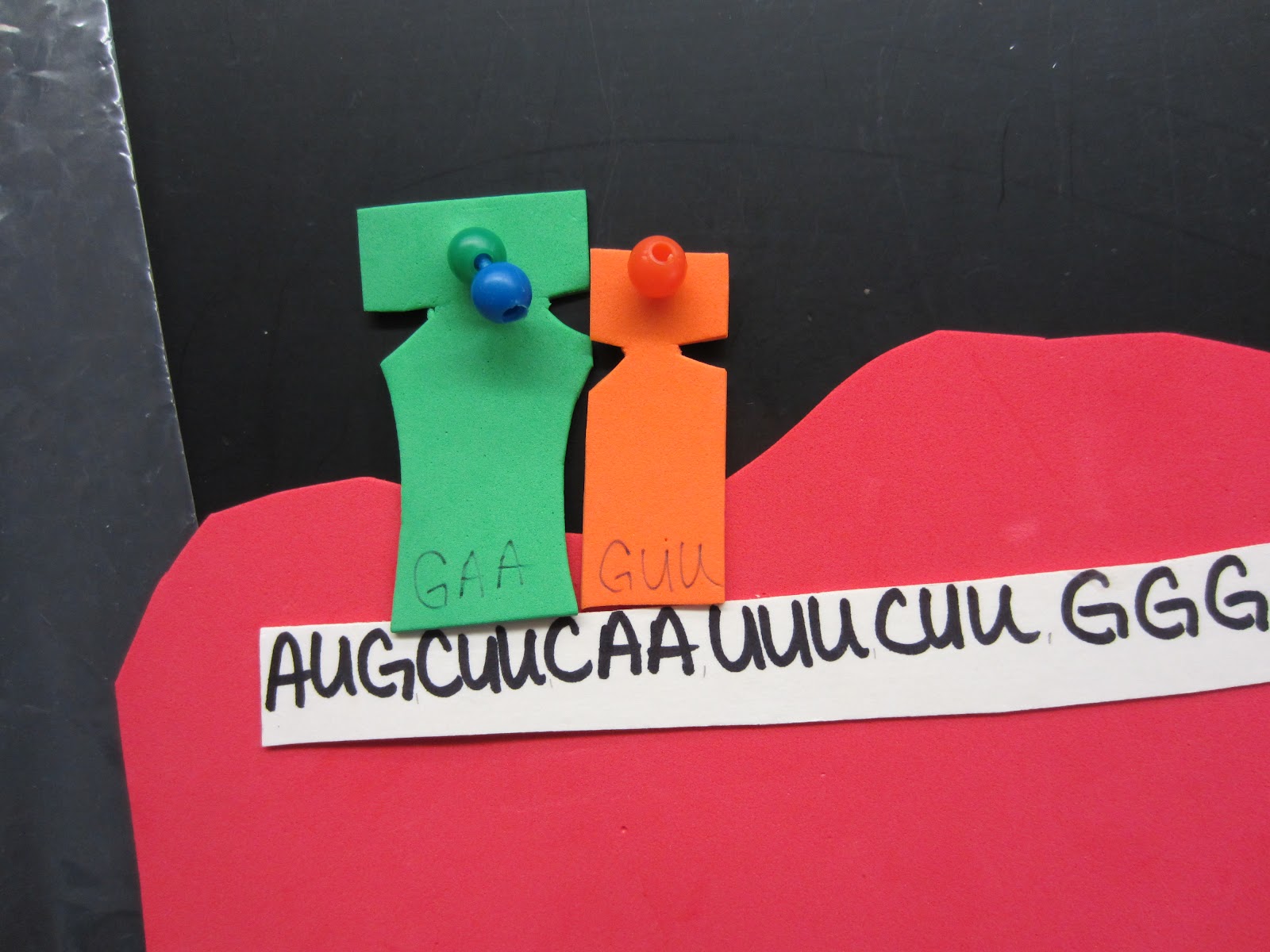 |
| The Chain continues to grow each time the new amino acid being added to the chain |


 |
| This will continue until...... |
 |
| STOP (Hammer Time) |
 |
| Once a STOP codon is reached the Amino acid chain is released and you have just created a Protein! |
 |
| I then had you write out your entire mRNA sequence and the amino acid sequence that resulted from it...... |
Tuesday, April 24, 2012
Intro to Translation
We have made it through transcription and now will step into Translation. The daily questions for today did a good job of wrapping this up and leading us in to translation.
Tuesday April
24th
At
the end of transcription what SPECIFIC type of molecule has been made? mRNA (messenger RNA because it is carrying the "message" that DNA has to be "read)
What
happens to the DNA molecule that coded for it? It zips back up again and remains unchanged.
Where
will this product now go? The mRNA will leave the nucleus, head out to the cytoplasm and eventually make its way into the ribosomes.
What
PROCESS will it now go through? Translation
What
will now be created? Proteins (a Chain of amino Acids)
 |
| Beginning of Notes on Translation |
We then started into the notes on Translation. If looking on Edline for these - you will download the Transcription/Translation notes and scroll through until you hit Translation.
We will be doing an activity to show you how translation happens and also will have an open notes quiz on THURSDAY that sums up transcription and translation. KEEP UP WITH THE NOTES!!!!!
 |
| Overview of Translation (Keep in mind - there are NOT more than one ribosome, it is showing how the ribosome moves down the mRNA molecule |
Monday, April 23, 2012
Transcription Wrap Up
Today we started with the following daily Questions and explanations
 Monday April 23rd

I then showed you how and where transcription occurs
The rest of the period we worked on a handout wrapping up transcription and another that takes a look into translation which we will start in to tomorrow!!
 Monday April 23rd
*The Process by which DNA is coded into RNA is known as Transcription
*In Eukaryotic cells this occurs in the nucleus
*The place on the DNA where this process begins is known as a
Promotor Site
*What Enzyme attaches itself this part of the DNA? RNA polymerase
*Where does this enzyme STOP on the DNA molecule? Site of Termination

I then showed you how and where transcription occurs
Thursday, April 19, 2012
How to Extract your OWN DNA!!!
Just found this video of how you can extract and view your own DNA!!! Take a look :)
Introduction to Gene Expression
Now that we actually had a chance to SEE DNA - we will move into what it actually DOES. Just looking at DNA doesn't really tell us much about its importance. We saw that in fact it's not the most glamorous thing to look at. So HOW do we possible get from that "snotty" looking stuff to getting ALL of our traits from it?!?! That's the next part of this chapter. The daily questions for today began with some basics of this
Here is a clip from iTunes U that also discusses these differences
Don't forget DQQ tomorrow - we will start off class with a daily question then take the quiz!!
Thursday
April 19th
DNA ultimately codes for what organic molecule? Protein
The place in the cell where this organic molecule
is made is known as the Ribosomes
In order to do this, another set of instructions
needs to be made, the name of this molecule is RNA
We then started into the RNA and Gene Expression notes. (Check Edline)
The start of this was just a description of RNA and how it differs from DNA. This is something we discussed in general at the beginning of the chapter but will now move into more detail.
 |
| Slide from today's notes |
Here is a clip from iTunes U that also discusses these differences
Don't forget DQQ tomorrow - we will start off class with a daily question then take the quiz!!
Wednesday, April 18, 2012
Extracting DNA from Strawberries!!!
 |
| What you need to do this at home!! Strawberries, Salt, Dishwashing detergent, a funnel, and rubbing alcohol!! |
 |
| First you Grabbed your Bag of strawberries |
Today we had fun times extracting DNA from Strawberries! Why would we use strawberries? Well, the nice thing about strawberries (other than they are good to eat and smell better than peas which is the other option?!?!) Is that breaking through the cell wall/cell membrane and nuclear membrane of strawberries is fairly easy with a simple DNA extraction buffer. Ripe strawberries also produce enzymes (Pectinases and cellulases) which help in breaking down cell walls. ALSO - Strawberries are Octoploid - meaning they have EIGHT of every chromosome. (which = LOADS of DNA to extract). So here is a run down and pics of todays lab!!
 |
| Next you grabbed a beaker and filled it with 10ml of DNA extraction Buffer |
 |
| The DNA Extraction buffer consisted of Dishwashing detergent salt and water. the detergent contains enzymes that help to break apart the lipid bilayer (remember lipids are fats and the cell membrane is a made up of fats). |
 |
| Mash up the strawberries!! |
 |
| Add the DNA Extraction buffer and smash again!! |
 |
| Filter the mixture through the coffee filter to capture just the juice |
 |
| Slowly add the Alcohol to the top |
 |
| You can start to see the DNA pulling out of the mixture and into the Alcohol. |
 |
| And I present to you.... STRAWBERRY DNA!!!!! |
 |
| A Day's worth of DNA |
Tuesday, April 17, 2012
Open Notes Quiz and Finishing up DNA models
Today we started off class with the open notes quiz on the structure of DNA and DNA replication. The rest of the period was spend finishing up your DNA model's drawings and descriptions. With the last couple minutes left in class I so kindly showed you the following YouTube video. I KNOW how much you love to hear all that we have learned in the form of songs/raps.... so here ya go ;)
Some of you then were SOOOO impressed with this one that i showed you the beginning of another. The next thing we will be moving into (after we extract DNA from strawberries) is transcription and translation. The first part of this you have learned about. As soon as it starts talking about mRNA though....wait until Thursday and you will see what that is all about!!!
Monday, April 16, 2012
DNA Replication Activity Day
Today we started off with the following Daily Question looking at the difference between Prokaryotic and Eukaryotic Replication.
About how many points of replication do eukaryotic
cells have?
We then worked with the K'nex Models and went through DNA replication. First I had you build your original DNA molecule from last week.
After reviewing all the different parts of the DNA molecule (deoxyribose, Phosphate groups, hydrogen bonds, nucleotide bases) I had you go through DNA replication.
First you acted as DNA Helicase by Unzipping the nucleotides by breaking the Hydrogen bonds.
You then acted as DNA polymerase by adding new nucleotide bases to either side.
At the end of replication you had two identical DNA molecules. Each had one "old" strand - or template strand and one "new" strand or daughter strand.
Ultimately what you just created was "sister chromatids" that will now allow the cell to go through mitosis. (remember that the chromosomes line up in the middle and pull apart leaving you with two genetically identical nuclei and then two identical cells form after cytokinesis.)
Monday
April 16th
How does Prokaryotic and Eukaryotic DNA replication
differ?
In the number of replication points.
How many points of replication do prokaryotic cells
have?
Just one - remember, Prokaryotic cells DNA is found inside the nucleus in a single circular loop. This loop will open up in one spot and proceed in either direction until they meet again. They will then split from each other.
MANY - (About 100) Remember, Eukaryotic DNA is found inside the nucleus in the form of many chromosomes. If each Chromosome started at one side and went the other it would take over 30 days for all the DNA to replicate. We know that our cells divide much quicker than that, so that is why it is so important to have many points of replication.
By having more points of replication does DNA
replication happen slower or faster? Faster
 |
| The arrows show how there are MANY different points of replication in Eukaryotic DNA. |
We then worked with the K'nex Models and went through DNA replication. First I had you build your original DNA molecule from last week.
 |
| Making Original DNA model |
First you acted as DNA Helicase by Unzipping the nucleotides by breaking the Hydrogen bonds.
 |
| Breaking Hydrogen bonds (Acting as DNA Helicase) |
You then acted as DNA polymerase by adding new nucleotide bases to either side.
 |
| New Bases are added to BOTH sides |
 |
| Adding new bases - playing the role of DNA Polymerase |
At the end of replication you had two identical DNA molecules. Each had one "old" strand - or template strand and one "new" strand or daughter strand.
 |
| Two exact DNA molecules each with one old (gray) and one New (yellow) strand |
 |
| Note how the Old of one is the New of the other and vise versa |
Friday, April 13, 2012
Pics from the week!!!
Today was carnival day.... which meant a lot of people missing! But alas - we still chugged along! I started you off with a couple daily questions about DNA replication BEFORE we took the Daily Question quiz. Here they are!!


We then went over it and those classes that did not finish the notes yesterday finished those off. We will work with DNA models again on Monday. There were just too many people missing today to try and work with them! Here are some pics from earlier this week when you DID get a chance to work with them!!
Friday April 13th
There are two enzymes involved in DNA
Replication. The first one
DNA Helicase unwinds and “unzips” the double helix.


The second one DNA Polymerase adds new nucleotide
bases at the replication fork. It
also acts as a “Proofreader”.


At the end of DNA replication we have two identical
DNA molecules. How are these two
molecules related? (This is the reason that DNA replication is known to be
“semi conservative”) Each of the two DNA molecules has One Old strand (template strand) and one New Strand
We then went over it and those classes that did not finish the notes yesterday finished those off. We will work with DNA models again on Monday. There were just too many people missing today to try and work with them! Here are some pics from earlier this week when you DID get a chance to work with them!!
 |
| Adding Nucleotide bases to the Sugar phosphate Backbone |
 |
| Twisted into a "double helix" |
 |
| Finished Structure |
Subscribe to:
Posts (Atom)