What type of bond holds together this water molecule?
Because of this there are “partial” charges associated with it.Which end acts +, which acts -? (Label those)
Using the models in your tubs – make 5 water molecules then place
how you think 1 would bond with 4 others.
What type of bond holds two water molecules together?
Remember EACH of these would then be bonded to four Water
molecules which leads to a very complex crystal form
We then took one slide of notes on Cohesion and surface tension then got to see that in action! Check the next blog post for pics on this activity. (Remember - get notes off Edline if you are absent)
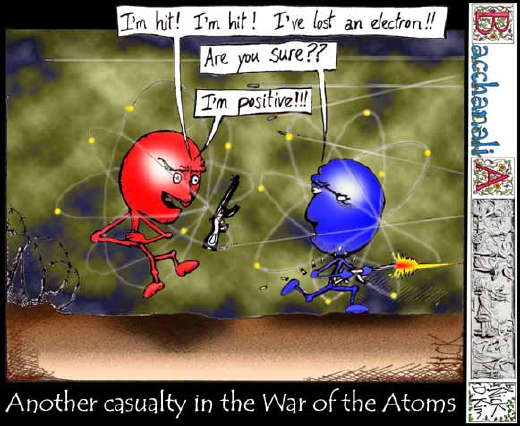
Based on this cartoon – What type of Bond is this “marriage”
depicting? An ionic bond since he is GIVING his electrons away. Remember - I told you a way that I was taught to remember Ionic bonds is "I OWN it." He GAVE her his electron so now she OWNS it!
What if instead the “boy” atom said “I do, Let’s share our valence
electrons baby” Which type of bond
would it be referring to? This would be a covalent bond. Remember I told you that the prefix "co" means together, share or both. In covalent bonds electrons are SHARED between two atoms.
After that we started into our discussion on water and its INCREDIBLY unique properties. First I had you watch the following clip from the Waterboy.... WHY?!??!! Because we are going to see that water does NOT suck and Gatoraide wouldn't have the effect it did if water wasn't the amazing molecule it IS!
We are in for some hands on stuff over the next couple days!!! It may be hot in here - but we'll make the best of it :)
Then we started into notes about water. Most classes got to the point of drawing out water molecules, seeing what makes it "polar" and then made some water molecules with pop-it beads.
Making water molecules out of pop-it beads
Note the "mickey mouse" shape of the water molecule. This is due to the fact that water is held together by POLAR Covalent bonds - so the electrons are shared unevenly!!
4 perfect little water molecules! Tomorrow we will see how they interact with each other
Our nucleus prop
Not MUCH hapening - just a bunch
of protons and neutrons hanging out!!
Daily Questions Wednesday September 5th
The nucleus of an atom contains which subatomic particles? Protons and Neutrons
Of these two – which defines an element? Protons(remember - that is really the only real "EXCITING thing" about the proton is that it defines the element. Not much going on - I related it to the "couch potato" of the atom.
Watch out - you slack off in here and
an electron may come flying your way.
Gold has the atomic number 79. How many protons are in an atom of gold? How many electrons are there?
79 Protons and 79 Electrons (Remember - in an elecrtically neutral atom, the number of protons = the number of electrons)
Which part of an atom is important in bonding and determining the
charge of an atom?
Electrons "The MUCH more exciting and 'electric' part of the atom!!"
An atom that has a charge is known as an Ion
How was this charge acquired? By the gaining or losing of Electrons
Today we continued through the notes on ions and in to bonding. I told you I would never make you learn something that I couldn't give you a reason WHY you should know it. That is why after the discussion on ions I played the following pod cast on electrolytes. We will continue to see how this all plays a role in "life" as the chapter goes on!
Keep holding on to those papers I gave you yesterday, we will be working through the content of them over the next couple days and I will let you know when they are due soon!
Today's daily questions were a review of what you learned in Physical Science. Here they were:
Tuesday September 4th
Let’s see what you
remember from physical science!!!
The smallest unit of matter is known as an Atom
Fill in the following table matching the parts of an atom with its
charge
Part of atom
Charge
Proton
Positive
Neutron
Neutral (No)
Electron
Negative
After that we started into some notes on basic chemistry. Please check edline for these - most classes made it through the slide on ions.
We then did some work in the books. I had you answer some questions on the first section - we will continue to do this tomorrow. (Have some notes time and some book time).
As an extension to our lab from Wednesday - I had you see how yeast makes bread dough rises while you took your first Daily Question Quiz (DQ2) on the characteristics of life and proper experimentation. After that we discussed a little more how microorganisms are used in creating different food products. For instance - ever wonder how swiss cheese gets the holes in it?
Check out this video!
Congratulations on making it through your first full week - Enjoy your Three day Weekend!!!
The Daily Questions for today dealt with making a proper experiment and following the steps of the scientific method. You have learned about the scientific method and proper experimentation by Mr.McConahy and/or Mr.Timmerman. Because of this, I am not going to spend a ton of time teaching you this on its own, but during labs throughout the year we will revisit the importance of both of these.
Thursday August 30th
Yesterday we performed a controlled experiment. Why do you think it was important that
the ONLY thing we changed was the amount of sugar we fed the organism? (Each
test tube had the same amount of yeast, same amount of water, the same color
balloon, the same size test tube, etc.)
By only changing ONE variable, we can draw accurate
conclusions. If we changed both
the amount of sugar AND the amount of yeast for instance, we would not be able
to tell if the results we got were because of the sugar, or because there was
more yeast.
“If we feed the yeast more sugar, then it will produce more
waste”
This statement is an example of a:
A. Theory B.Experiment C.Conclusion D.Hypothesis
This is a hypothesis because it can be tested. A THEORY is something that has already
been tested and proven true over and over.
The rest of the period I gave you guys time to answer the Lab questions and finish your note cards from yesterday.
REMEMBER OUR FIRST DAILY QUESTION QUIZ IS TOMORROW!!!!
I started you off with daily questions to get you thinking - but as a CLASS we didn't answer them. I asked you to work within your group to see if you could start to do this on your own. I have told you before and will tell you again and again, Get comfortable with being a little confused. IT'S OK!!! Don't SETTLE (our motto for this year) for being confused though - work it out!!!!
Collaborate with each other and see what happens!!! Here were the questions and answers.
Wednesday August 29th
The fact that we sweat when it
is hot outside could be an example of two different characteristics of
life. Which two and why? Homeostasis - because we are trying to maintain a constant body temperature. Respond to Stimuli because we are responding to our environment.
Determine which choice best
answers the following question. (Be prepared to tell me what is wrong with the
others)
Which
characteristic is share by all prokaryotic and eukaryotic organisms?
A. Need for a source of energy(Correct answer because this is metabolism)
B. Ability to make their own food All organisms don't make their OWN food, but all organisms to go through metabolism.
C. Ability to reproduce asexually Not all organisms reproduce asexually, but all organisms DO have the capability of reproducing.
D. Need for oxygen for respiration Not all organisms need OXYGEN for repiration, but all organisms do go through different forms of metabolism.
E. Have Feelings Not all organisms have feelings - but all organisms DO respond to stimuli in some form.
I also had you working through your first lab, see a future blog post about this and we will discuss what happened tomorrow!! Great job today with your first lab. It was a little chaotic, but sometimes labs get that way. As long as we are focusing on our goal, a LITTLE chaoes never hurt anyone ;)
All living organisms can be
classified as prokaryotic or Eukaryotic.
These names tell you the type of Cell that make them up. Of these two types, bacteria are
considered Prokaryotic
An organism’s ability to
maintain a constant internal environment in an ever-changing external
environment is known as Homeostasis
Give me one example of this. Maintaining a constant body temperature, blood glucose level, blood oxygen level. As well as MANY more!!! ANY time our bodies start adjusting to a changing cellular environment to keep a constant internal environment is an example of homeostasis.
After the daily question we continued throught the notes on the characteristics of life including metabolism, reproduction, repsonse to stimuli and growth. I hope that over the next three days we will be able to actually LOOK at some of these characteristics in real life!
Here were some of the slide we looked at.
How do we maintain a constant body temperature?!?!
Today was your first set of notes! We started the class with the following daily questions:
In order to be considered alive - all living organisms must contain at least one Cell.
Within that (cell) all living organisms contain a molecule of DNA which codes for everything about the organism.
True or False: If something moves then it is alive. Why or why not? FALSE: Just because something moves (like my car) does not mean it's alive and just because something DOESN'T move (Like a tree) does not mean it ISN'T alive.
I then let you guys see the "Movie Trailer" to this section. Here it is again for you to see. There were some good questions in here to keep in mind as we go through these notes.
We then started into the characteristics of life notes. Please check Edline if you missed any of these.
We got through the slides dealing with cellular organization and some of the examples of homeostasis. Tomorrow we will continue through these notes with the hopes of doing our first activity on Wednesday and Thursday this week!
This week we will be answering the following question
We saw on Friday that biology is the study of life - so...... what does it mean to be "Alive" All the "creatures" shown on the slide above are alive and there are SEVEN things that ALL of them have in common. By the end of this week I hope that we will be able to discuss, differentiate and categorize different characteristics of life and give specific examples of how we can see each of these characteristics in any living organism.
Today I started the class with our first set of daily questions. This is how just about EVERY class period will go. When you enter class, start writing down the daily questions in your notebook and looking for the answers. I already received the question "Do we have to write down the question?" YES!!! While today's may not have seemed necessary, other days it will be crucial. Most Friday's we will have a Daily Question Quiz (DQQ) that are based off of these, you will not be able to actually USE your notes, but that is what you want to use to study for them. By only having answers written down without questions, you will not know what you are studying!! This will make more sense as the year progresses. Here were today's Daily Questions:
Friday
August 24
How
many times can you use a hall pass in a nine-week period? THREE (This includes if you let me know before class that you need to stop at your locker or go the restroom before class. If you are back in class after the bell rings - that was a hall pass usage. After you have used your three hall passes those would be considered tardies)
What
parts of the class can you use them?
First or last 5 minutes of class.
Biology
is the study of what? Life. The term "-ology" means "The study of" and the prefix "Bio" means "life" (For instance - a BIOgraphy is a story of someone's LIFE)
Tell
me one characteristic that you think defines “life”
*** I had you guys brain storm this together and you came up with a lot of these on your own. I was very pleased with how you worked through this and look forward to doing this more often with daily questions (having at least one that you discuss together and answer on a note card)
The correct answers are:
cellular organization(All organisms contain at least one cell), homeostasis (The ability to maintain a constant internal environment), metabolism(taking in nutrition and releasing waste), responsiveness, reproduction, heredity(all living organisms contain DNA), and growth.
We will be looking at this in more detail on Monday and will probably have this as a daily question again.
In the discussion of metabolism I was able to give you the first "real world" example about Morning breath. Here is a clip that discusses what I did about morning breath really being the result of Bacteria Metabolizing in your mouth. So morning breath is sort of "bacteria farts"
Welcome Back!!! Here we are at the beginning of another school year!! Today I showed you guys a welcome back video that introduced a little about what to expect and what I will be expecting of you. I have great expectations for this year!! I then had you tell me a little about yourself as both a person and a student. This is INCREDIBLY important to me and I am very grateful for your participation in that "getting to know you" survey. Tomorrow we will start the class off with Daily Questions to get us into the "routine"of how this class works! If you missed the video - here it is!!
Hopefully this is NOT the math you have done in determining if you are going to study or not for this exam :)
Last full week of school for you guys!!! This week we will be spending preparing for our final. Today I had you take last years final for a couple different reasons. First off, I wanted to refresh your memory as to how far back this information goes. Next, to see what areas that you seem to be solid on and what areas I know we need more review on. I will be putting together a couple review games and will make them available to you as soon as I get them typed up!! Hang in there guys!!!
Most of you finished the notes on this section yesterday. Today we went back through and I highlighted a few key areas. Most specifically we talked about how there is a delicate balance between the ability to not only survive but also reproduce. Embedded in the notes was the following video clip that summarizes this balance.
You then received questions on this chapter that will act as your test. I mentioned before that there would not be a stand alone test for this chapter but it WILL be a part of your final. Tomorrow we will have an open notes quiz, Friday we will have a daily question quiz and what i handed out today will be due on Monday.
Here were today's daily questions.
Tuesday May 15th
*What did Darwin believe fueled evolution (1st step of
evolution by natural selection) Overproduction (The fact that organisms have the capability of producing more offspring than the environment they live in can hold)
*This was based off of Malthus’ findings that human population grows
Exponentially while the food supply grows Linearly.
*The second step in Darwin’s theory is that individuals in a population
exhibit variation. This
“variation” is due to different Alleles.
*Which statement best describes a current understanding of natural
selection?
A.
Natural selection influences the frequency of an adaptation in a
population
B.
Natural selection has been discarded as an important concept in
evolution
C. Changes in gene
frequencies due to natural selection have little effect on the evolution of species.
D.
New mutations of genetic material are due to natural selection.
Today we dove a little deeper into Darwin's idea of natural selection. He had 4 steps he believed had to occur for evolution to occur. What fueled evolution by natural selection was overproduction. (this idea was in part due to Malthus's ideas about human population growth vs food supply). We also looked at what nature actually "selects" for. We discussed some different adaptations that may have an advantage such as camouflage and mimicry.
Today's Daily Questions:
Darwin applied his findings to how humans breed
animals for certain traits. This
is known as……..
Artificial Selection
One of Darwin’s Influencers, Lamark believed that
what was passed on to future generation was dependent on what? - The Use or disuse of a trait
We continued today with looking at not only Darwin, but those who influenced Darwin's ideas.
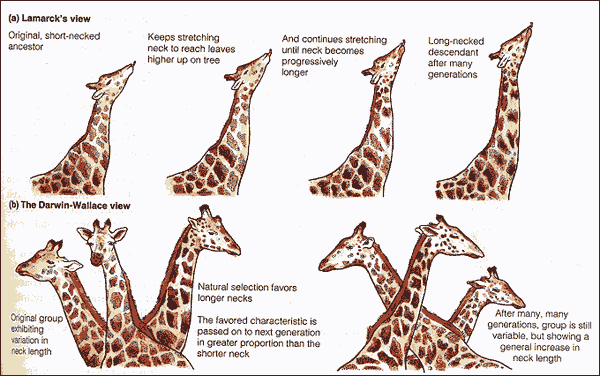
Lamark felt that traits that are USED are passed on. So he thought that giraffe necks had grown longer from stretching them so much.
If Lamarks idea held true that would mean the the son of this baseball pitcher would automatically have a strong arm.
I want to stress again that we will be applying our understanding of genetics and heredity to what Darwin was seeing. I mentioned before that during the time Darwin was coming up with his ideas there was no scientific knowledge about heredity or DNA so he referred to all of this as "variations" and "Copying mechanisms" Please continue to check edline for the notes. Today's Daily questions were as follow
*What did Darwin notice about the finches and what did that lead him to believe about the “evolution” of them? He noticed that their beak shapes directly corresponded to the type of food they ate. What he theorized was that the finches has migrated from the main land of South America and overtime adapted to different food sources. He called this "Descent with modification"
*With our understanding of genetics, these different “variations” are known as what? Alleles
*What do you think caused these different variations? Mutations
*What two types of variations do you believe would provide an “advantage” to a species? Any allele that would allow them to survive (eat and not be eaten) and reproduce.
After the test on Tuesday I let Wednesday be a make up day. Today though we started in to our LAST chapter of the year!!!! Evolution and natural selection. You did learn a little about this in 8th grade environmental science but we are going to move a step farther and look at the GENETICS behind it. You saw today that this chapter is going to be a good way to put together ALL we have learned this semester. The daily questions today acted as a "pre-test." These were sample keystone exam questions. After the daily questions we started into the beginning of the notes giving a background on who Charles Darwin was and what his discoveries were. There was a little clip that i had you watch below
When the crazy bird was talking - THAT was when it started to bring the last chapter into play. He mentioned that there must be some "copying" mechanism that can have "errors" in it for new traits to arise. We discussed that the "copying' mechanisms would be mitosis and meiosis followed by fertilization and the "errors"would be mutations then.
So.........how are we going to put this into action?!?!? We will be looking at why using SOOOOOO much hand sanitizer and the over use of antibiotics are creating "super bugs" that are resistant to EVERYthing!!!! So lay off the hand sanitizer guys :)
Here were your daily questions - please check Edline for the notes!!
1. Which population of organisms would be in greatest danger of becoming extinct? ***A population of organisms having few variations living in an unstable environment. *Having little variation is not a good thing when a major environmental change occurs.
2. In order for a new species to develop, there must be a change in the **Genetic makeup of a population. (This can be DUE to a change in the temperature or migration patterns, but ultimately it comes down to a change in the allele frequencies of a population)
3. Which statement is NOT part of the concept of natural selection?
A. Individuals that possess the most favorable variations will have the best chance of reproducing.
B. Variation occurs among individuals in a population
C. More individuals are produced than will survive D. Genes of an individual adapt to a changing environment***GENES do not adapt - individuals adapt and populations adapt - but genes do not. They may "change" due to random mutations though.
** 2 - a decrease in the advantage of having white fur. Since over a 10 year period the presence of ANY white rabbits was eliminated, that most likely means that having white fur was no longer a good thing.
Today was a day to prepare for the DNA-RNA-Gene Expression Exam. You will use Honors Bio link for the review game. PLEASE refer to this as well as the study guide in preparation for this exam. This is NOT the time to "check out" from school. We still have 3 weeks of content before we begin preparing for the final. Many of you cannot afford to let this 9 weeks go down the drain. As always.... talk to me / email me if you are confused on something or if you have realized the hole you have dug yourself is one that you wish to pull yourself out of!!!
We have slowly but surely been wrapping up this chapter. Today I gave you a study guide full of questions that sum up this chapter. Tomorrow we will have our usual Daily Question Quiz and then you will have time to continue with that. Monday I am planning for our formal review with the test being on Tuesday.I will have you turn in this packet on Tuesday so you have it to study for the test. We are almost there guys!!Hold strong and "Just keep swimming, just keep swimming, just keep swimming, swimming, swimming" - I know its hot in here - complaining about it doesn't make it any better!!
Today we finished up the notes on mutations and watched a clip about a specific mutation that causes Polydactylism (having extra fingers/toes) we started the class off with the following daily questions
Wednesday May 2nd
**True or False: Mutations = ALWAYS BAD…… FALSE!!! A mutation does not ALWAYS mean something bad will occur. Mutations can be adventagous at times, they can be harmful or they may simple have no affect at all on a characteristic. The term mutation simple means there is a change in genetic material.... The end!!!!**Which statement is true regarding an alteration or change in DNA? A. It is always known as a mutation
B. It is always advantageous to an individual
C. It is always passed on to offspring
**A mutation occurs in a cell. Which sequence best represents the correct order of events involved for this mutation to affect the traits expressed by this cell? A. Change in DNA bases → Change in amino acid sequence → change in appearance of characteristic
B. Change in amino acids → change in DNA bases → Change in characteristic
C. Change in characteristic → change in amino acids → change in DNA bases
D. Change in DNA bases → change in characteristic → Change in amino acids
**True of False: DNA that is mutated in our lifetime in somatic cells will be passed on to our offspring. FALSE!!! Only DNA inn our germ line cells (those that will go through meiosis and become our gametes) will be passed on to our offspring. Mutations that occur in our somatic cells DURING our life will not be passed on.
**Which of the following types of mutations would have the greatest affect on the protein that the gene codes for? Missense, Silent or nonsense? Nonsense: A nonsense mutation causes a premature stop codon - so the rest of the amino acid chain will not even be made. Missense can still have a large affect on the protein, but in general we would probably see the biggest affect with a nonsense mutation.
After the daily questions and finishing the notes on mutations I had you watch the following clip. We talked about the trait for 6 fingers when we learned about heredity. If you recall I mentioned that having 6 fingers was actually a dominant trait. What that means is in order to have a child with 6 fingers, one of the parents HAD to have had Six fingers. In this case the father did, but as with most people who are born with an extra didget - it was removed as a child. The odd thing about this case is that the baby has a fully functional 6th finger AND 6th toe. This now brings into our discussion on gene expression. Rememer, when and how genes are expressed is VERY complex. Obviously this little boy is fully expressing the gene in both his hands and feet. His father, on the other hand, may have only been expressing the gene "slightly" in his hands and not at all in his feet.
Today started our notes on mutations. A key misunderstanding with the term "mutation" is that it means "Bad" or "Freakish". Not all mutations turn you in to Frankenstein..... I PROMISE you that!!! The daily questions gave you a look into the different effects mutations can have.
Using your codon chart – translate the following mRNA sequence
AUG CCA UAC CGC CGG UUU
Met – Pro – Tyr – Arg – Arg - Phe
What would happen if the following letter changed?
AUG CCG UAC CGC CGG UUU
Met – Pro – Tyr- Arg – Arg – Phe
The amino acid sequence remained the same – “Silent” mutation.
AUG CCA UAC CGC CAG UUU
Met – Pro – Tyr – Arg – Gin – Phe
“Missense” mutation
AUG CCA UAGCGC CGG UUU
Met – Pro - STOP
“NonSense” mutation
We then started into the notes about mutations. We will continue with these tomorrow!! Check Edline for the notes.